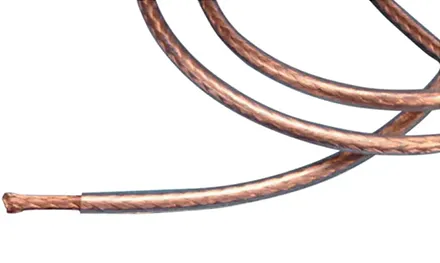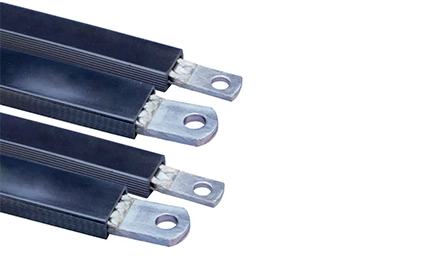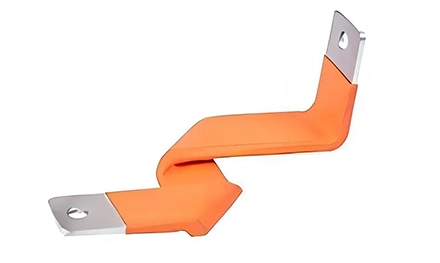


A Braided Flexible Connections conductor resists vibration because its core is not a solid bar but a weave of hundreds of fine copper wires. The RRCBI construction uses 560 to 900 individual 0.15mm wires braided into a round profile, so when the assembly vibrates, the wires flex against each other instead of transmitting the stress to a rigid terminal. This article explains how the braided structure absorbs movement, what the 1mm PVC insulation contributes to safety, and what to verify when you're specifying an insulated round braid for power distribution or earthing.
A solid copper bar transmits vibration directly from the equipment frame to the bolted connection. Over time, that repeated stress loosens the terminal or cracks the conductor. A braided conductor distributes the movement across hundreds of wire strands, so each strand sees only a fraction of the total displacement.
The RRCBI uses 0.15mm wire diameter, which is fine enough to flex without work-hardening. The braid structure allows the conductor to bend, twist, and compress in service—a property that matters in EV battery packs, rail traction boxes, and switchgear that experiences continuous mechanical cycling.
The conductor is made from plain copper, a non-magnetic material. That matters in AC power distribution, where a magnetic conductor would introduce eddy-current losses and localized heating. The non-magnetic construction keeps the conductor electrically efficient across both AC and DC applications.
The RRCBI is available in two standard cross-sections. The 10mm² version carries 75A and has a diameter of 7mm. The 16mm² version carries 120A and measures 8mm in diameter. Both versions use 1mm PVC insulation rated for 450V, and both operate up to 70°C.
The insulation carries a UL94 V-0 flammability rating, which means the PVC self-extinguishes if exposed to flame. That rating is relevant for switchgear and control panels where a fault could expose the conductor to an arc.
| Parameter | RRCBI15-10 | RRCBI15-16 |
|---|---|---|
| Nominal current | 75A | 120A |
| Cross-section | 10mm² | 16mm² |
| Number of wires | 560 | 900 |
| Wire diameter | 0.15mm | 0.15mm |
| Length | 25m | 25m |
| Diameter | 7mm | 8mm |
| Insulation thickness | 1mm | 1mm |
| Insulation voltage | 450V | 450V |
| Max temperature | 70°C | 70°C |
| Flammability | UL94 V-0 | UL94 V-0 |
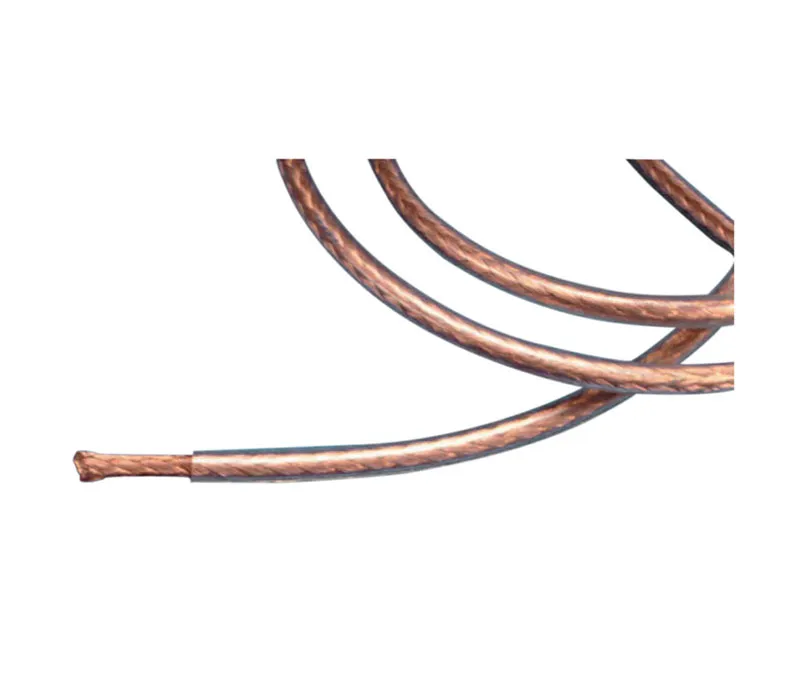
A Braided Flexible Connections conductor is used where a rigid bar would fail under movement or where a cable would be too stiff to route. The RRCBI is specified for power distribution and earthing applications, which covers switchgear connections, transformer grounding, EV battery pack links, and industrial control panel bonding.
The round profile and the PVC jacket make the conductor suitable for indoor panel wiring where the braid needs to bend around components. The insulation protects the conductor from accidental contact with adjacent phases, and the flexibility allows the installer to route the connection through tight spaces without custom bending tools.
The 1mm PVC jacket provides a dielectric barrier rated for 450V. That voltage rating covers low-voltage distribution and control circuits, including 400V three-phase systems where the conductor operates near its rated voltage.
The jacket also protects the braid from abrasion during installation. A bare braid can snag on sheet-metal edges or shed copper strands when pulled through a panel. The PVC jacket contains the strands and provides a smooth surface for routing. The UL94 V-0 rating adds a flame-retardant layer of protection, which is a common requirement for conductors installed inside electrical enclosures.
The 10mm² version carries 75A, and the 16mm² version carries 120A. Match the conductor to the continuous current, not the peak. If the load sits near the top of a rating, step up to the next size to preserve thermal margin inside the enclosure.
The maximum operating temperature is 70°C. That limit is set by the PVC insulation, not the copper. If the ambient temperature inside the panel exceeds 70°C, a higher-temperature insulation—such as XLPE or silicone—would be required. Confirm the enclosure temperature before specifying the standard PVC version.
The manufacturer supports custom shapes and processing according to customer drawings. The production line handles die-cutting, molecular expansion welding, extrusion, injection molding, plastic dipping, and industrial heat-shrink tubing. For OEM projects, the conductor can be supplied in custom lengths, with specific terminal preparations, or as part of a larger busbar assembly.
A braided conductor weaves fine wires into a mesh, which gives excellent flexibility and vibration resistance but introduces small air gaps between strands. A laminated conductor stacks flat copper foils, which gives lower impedance and better heat dissipation but less flexibility in multiple directions. The braided type is preferred for grounding straps and low-current flexing applications; the laminated type is preferred for high-current EV and ESS busbars.
A finer wire diameter increases the number of strands for a given cross-section, which improves flexibility and vibration damping. 0.15mm is a balance between strand count and manufacturing cost. Finer wires would flex more easily but would increase the braiding complexity and the risk of strand breakage during termination.
The standard PVC jacket is rated for indoor use. For outdoor or high-moisture installations, the conductor should be housed inside an enclosure or specified with a weather-resistant jacket. The 70°C temperature limit and the PVC material are the constraints to check against the site conditions.
UL94 V-0 is the highest flammability rating under the UL94 standard. It means the PVC jacket self-extinguishes within 10 seconds if exposed to a flame and does not drip flaming particles. In a control panel, that rating reduces the risk of a small fault propagating into a larger fire.
A Braided Flexible Connections conductor should match your continuous current, system voltage, and the mechanical movement in the assembly—not the other way around. The RRCBI Insulation Braided Copper Conductor from Haiyan New Energy carries 75A or 120A at 450V with 1mm PVC insulation and a UL94 V-0 rating, using 560–900 strands of 0.15mm copper for vibration damping in switchgear, EV, and industrial grounding applications. The manufacturer supports custom shapes and drawings for OEM projects. If you're specifying an insulated round braid for a power distribution or earthing connection, send us your current, voltage, and routing requirements — we'll help you confirm the right cross-section and termination before you order.
GET A QUOTE


 中文
 English
 Pусский
 Français
 Español