

You're specifying interconnects for a control cabinet, a wind turbine hub, or a traction system. The environment throws vibration, condensation, and heat at every component. Standard connectors fail—contacts loosen, seals crack, insulation breaks down. So when you evaluate heavy duty connectors, you need a clear set of criteria that separate rugged designs from overpriced standard parts. This guide walks through the real-world specs: current-carrying capacity, ingress protection, terminal retention, and material choices. No fluff—just the practical checkpoints that help you select a connector that outlasts the equipment it serves.
The nameplate current rating is a starting point, not a guarantee. A connector rated for 40A at 25°C may only handle 30A at 60°C ambient. Always check the derating curve. The contact material and cross-section determine how much heat the interface can dissipate. Silver-plated copper offers low resistance but tarnishes in industrial atmospheres; gold plating resists corrosion but costs more. For high-power applications, look for temperature rise data—a rise above 50°C over ambient is a red flag.
Every termination introduces resistance. Over time, oxidation and mechanical stress increase that resistance, generating more heat. A connector with an initial contact resistance of 0.5 mΩ can double after 500 mating cycles if the plating is too thin. Request millivolt drop test results from suppliers to verify long-term stability.
Plating thickness is often overlooked. 0.76 µm gold over nickel is common for signal pins; 2 µm silver suits high-current contacts. Thicker plating extends wear life but raises cost. Match the plating to your expected number of insertions and environmental corrosivity.
IP ratings tell you what a connector keeps out, but they don't tell you how long it keeps it out. An IP67 seal relies on an elastomer O-ring; its longevity depends on material compatibility with oils, UV, and temperature cycling. For outdoor wind or solar installations, IP68 with continuous immersion capability may be necessary. But remember—the seal only works if the cable gland is properly torqued and the mating surfaces are clean. A connector with an IP67 housing and a poorly fitted gland loses its protection at the cable entry.
Nitrile (NBR) resists oils but degrades under UV; silicone withstands extreme temperatures but swells in fuel. For outdoor applications, fluoroelastomer (FKM) offers the best balance of heat, chemical, and weathering resistance. Always specify the sealing material based on your operating fluids and temperature range.
The cable gland is the weak link. A poorly chosen gland or incorrect torque creates a leak path. Use PG or metric glands with the correct clamping range, and follow the manufacturer's torque specifications. Over-torquing distorts the seal; under-torquing leaves gaps.
The way a wire terminates determines long-term connection stability. Screw terminals are simple and familiar, but they require correct torque—under‑tightening creates resistance heating, over‑tightening strands the conductor. Spring-cage terminals maintain constant pressure regardless of vibration, making them preferred for railway and automotive applications. Crimp terminals offer the lowest resistance but require specialized tooling and quality control. For field wiring, spring or screw are more practical; for factory assembly, crimp can be superior.
Screw terminals – field-friendly, but require re-torquing after thermal cycling.
Spring-cage terminals – vibration-proof, faster wiring, but limited to smaller gauges.
Crimp terminals – lowest resistance, best for high-current, but require special tools and skill.
Incorrect strip length exposes too much conductor or leaves insulation under the clamp. Both cause failures. Use the strip length specified in the datasheet, and avoid nicking strands during stripping—nicks create stress risers that break under vibration.
The outer shell protects the insert and provides mechanical support. Die‑cast aluminum offers high strength, EMI shielding, and excellent heat dissipation, but adds weight and cost. Thermoplastic housings are lighter and corrosion‑free, but may degrade under UV or high temperatures. For applications with frequent mating cycles or heavy cable strain, aluminum housings with reinforced locking levers provide better durability. Check the impact resistance rating—IK07 or higher is typical for industrial environments.
Check the IK rating—IK07 (2J) is basic, IK10 (20J) is heavy-duty. For railway trackside or mining equipment, choose IK09 or higher. Aluminum housings generally outperform plastic in impact tests, but some high-grade polycarbonates reach IK10.
The locking lever or latch undergoes repeated stress. Stainless steel levers resist corrosion and fatigue better than zinc-plated steel. Test the locking force—it should require a firm but not excessive action. Loose locks lead to accidental disconnection; overly stiff ones frustrate field technicians.
Safety and performance certifications are non‑negotiable for commercial and infrastructure projects. Look for UL 1977 (industrial control connectors), CSA C22.2 (Canadian standard), and EN 61984 (European connector safety). These certify dielectric withstand voltage, insulation resistance, and temperature cycling. Always request test reports—certificates alone don't guarantee batch consistency.
For rail, EN 50155 adds vibration, shock, and temperature class requirements. For offshore, DNV GL certification may be needed. Always request the full test report, not just the certificate—some suppliers only test to the minimum.
In enclosed spaces, fire safety is critical. Look for UL 94 V-0 rating for housing materials, and for rail, EN 45545 smoke density and toxicity limits. These specifications are often mandatory for public transport and tunnel installations.
No single connector fits every use case. For rail transit, prioritize vibration resistance, flame retardancy, and low smoke emission. For wind power, focus on corrosion resistance (salt spray testing) and thermal cycling from -40°C to +85°C. For industrial automation, modular inserts that combine power, signal, and data in one housing save panel space. The best connector is the one that matches your mechanical, electrical, and environmental demands—not the one with the longest spec sheet.
Modern heavy-duty connectors support hybrid configurations—power + Ethernet + pneumatic lines in one housing. This reduces panel space and simplifies wiring. Ensure the insert frame and housing are compatible with your chosen mix. Check creepage and clearance distances for mixed voltage levels.
To prevent mismating, use coding pins or color-coded housings. For complex systems, custom keying ensures that only the correct mating pair connects, reducing assembly errors.
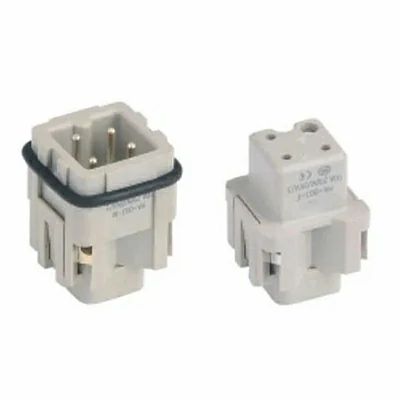
A connector that's hard to install or service becomes a maintenance burden. Consider termination space—can a gloved hand easily access the screws? Are cable entry options (top, side, bottom) flexible enough for your cabinet layout? Does the locking mechanism operate smoothly even after thousands of cycles? Field service teams appreciate color‑coded inserts and numbered positions that reduce wiring errors. Good design anticipates the person on the factory floor.
Clear marking on the hood or housing—such as terminal numbers, circuit labels, or color bands—reduces wiring errors. Laser engraving lasts longer than silk-screening. For large installations, pre-wired assemblies can be tested before shipment, saving on-site labor.
Ask about the availability of replacement inserts, seals, and levers. Field-repairable connectors allow you to change a damaged contact without replacing the entire connector—a significant cost saving over the equipment's lifetime.
| Selection Criterion | What to Verify | Why It Matters |
|---|---|---|
| Current rating | Derated for max ambient temp | Prevents thermal runaway |
| IP rating | Tested with actual cable gland | Ensures system-level sealing |
| Terminal type | Suitability for field vs. factory | Affects installation speed and reliability |
| Housing material | Impact and UV resistance | Determines outdoor vs. indoor use |
| Certification | Full test reports, not just certificates | Confirms batch-to-batch consistency |
How do I derate current for high-temperature applications?
Derating curves vary by manufacturer; typical rule is 10–20% reduction per 25°C above ambient. Always refer to the specific product graph—using a generic rule can be risky.
Can I use the same connector for both power and signal?
Yes, through modular inserts. Ensure the power pins have adequate clearance from signal pins to avoid arcing or interference. Check the dielectric voltage rating between mixed inserts.
What is the typical lifespan of a heavy-duty connector?
Lifespan depends on mating cycles, environment, and current load. Under normal industrial conditions, expect 5–10 years. Regular inspection of seals and contact resistance can extend service life.
How do I verify IP protection after installation?
Perform a visual check, ensure proper gland torque, and if needed, conduct a low-pressure air test with the connector mated. Some suppliers offer test kits for field verification.
Selecting the right connector requires balancing electrical, mechanical, and environmental factors. Get engineering support and a quote → —our team can review your application, recommend the optimal configuration, and provide samples for testing.
Haiyan New Energy has supplied interconnect solutions for power transmission, energy storage, rail transit, wind power, and heavy machinery for over a decade. The czljq8 Heavy Duty Connectors series exemplifies their engineering depth—offering modular inserts, die‑cast aluminum or thermoplastic housings, and multiple termination options across 130+ product families. All components are tested to UL, EN, and IEC standards, with full traceability. From custom labeling to hybrid power‑signal configurations, Haiyan's team provides design‑to‑delivery support for projects of any scale. Connect with them to discuss your voltage, amperage, and environmental specifications.
GET A QUOTE


 中文
中文 English
 Pусский
 Français
 Español